Annual awarded work
Tripled annual awarded volume with no added headcount.
13+ years in construction, from installing floors to leading estimating. I grew a bid department, then built and deployed AI software that helps each estimator deliver more.
Head of Estimating & Preconstruction, Summit Flooring Group
Founder, Kentucky AI · Creator, OpenTakeoff
Latest ConTech résumé · September 24, 2026 · PDF, 3 pages
Tripled annual awarded volume with no added headcount.
Up from approximately $550K–$1M per week, using AI software I built and deployed.
Business results reported by Michael, October 2026. Weekly figures describe bid value produced; annual figures describe awarded work.
Lead a three-person estimating team across a 13-state commercial flooring business. Own the workflow from bid selection and pricing through proposals and award handoff.
Built OpenTakeoff and Spline, deployed software in live estimating, trained users, and improved the workflow from their feedback.
Build computer vision models from pretrained weights, modifying initialization and task-specific heads. Work with fine-tuning and evaluation; know LoRA, QLoRA, and knowledge-distillation methods.
OpenTakeoff connects people and AI assistants to the same measurement tools. Spline brings that work into the estimating workflow.
I’m interested in roles connecting customer problems, product development, and successful adoption.
Shelbyville, Kentucky · Open to relocation and travel
I’m the founder of Kentucky AI and creator of OpenTakeoff. I bring 13+ years of construction experience to applied machine learning, agent tooling, and the evaluation of AI in real workflows.
 Kentucky AI · program member
Built, released, and reaching people. Cloudflare recorded approximately 3,160 page views across 477 filtered visits to opentakeoff.kentucky-ai.com, September 10–26, 2026.
Cloudflare Web Analytics snapshot saved September 26: production hostname only, bot-flagged traffic excluded, preview deployments and downstream self-hosts excluded, and 270 identified automation visits removed. Earlier days were sampled, so counts are approximate. Repeat visits and some owner traffic remain possible; visits are not unique people or completed takeoffs.
The 2,300 npm downloads are Michael’s reported OpenTakeoff MCP server figure as of October 7, excluding mirrors and bots; the reporting window and filtering have not been independently verified. GitHub: 161 stars and 68 forks, October 7. These sources cover different periods.
Deep domain knowledge, turned into working systems. Start with the code. Then watch it run.
A construction measurement engine with a browser canvas for estimators and an MCP interface for AI agents. Both use the same geometry and quantity calculations.
Measurements keep their scale, method, and review history. The person doing the work stays in control.
 DRAWING → MEASUREMENT → REVIEW
A model-by-model record of the architecture, training, evaluation, and release status published on Hugging Face.
Author-reported evaluation for one company’s cost structure. Weights and pricing data remain private; no public inference endpoint. The model card documents preliminary results and failure cases.
Pilot-scale holdout (n=4). This is a documented specialization experiment, not a general accuracy claim. Adapter weights are not distributed.
roles-e070b.pt · DeepLabV3 / ResNet50 · wall, fixture, annotation, hatch, backgroundwalls-e068.pt · SegFormer B2 wall segmentationwall_v0_noband.pkl · 36-feature wall classifierseal_v0.pkl · paired doorway-seal classifierexpanded_head.pkl · visual-context rejection of false wall candidatesComponent compatibility is validated; full-sheet accuracy is not certified. This release does not package the complete pipeline. Component licenses differ; SegFormer is research/evaluation-only.
Median bid-total error on the model card’s 51-project temporal holdout. Lower is better.
I build the server, the measurement contract, and the evaluation that checks whether the resulting work is useful.
Founder-reported October 7, 2026; mirrors and bots excluded.
Agents load plans, calibrate scale, measure geometry, inspect overlays, and export takeoffs through a stdio MCP server. The browser and server import the same measurement logic.
READ.
CALIBRATE.
MEASURE.
VERIFY.
Built the Commonwealth Agent Union and OpenTakeoff Academy: a place for agent evaluation, public evidence records, membership, and human-proctored qualification.
Early-stage platform. The site identifies its current benchmark reference as a single-plan, self-reported run; the hiring hall is preparing for funded work.
I built a harness that makes models use OpenTakeoff’s MCP tools, then scores their committed geometry against reviewed takeoffs.
Kimi K3 led mean floor IoU in this run, but its wall-face placement was much weaker. The benchmark separates geometric correctness, quantity error, completion, runtime, and cost.
Eight models, the same five private sheets, one retained trial per model/sheet. Anonymous scalar results and summary-reproduction code are public. Source drawings and answer geometry remain private.
Specific systems I have built and experiments I have run, across data preparation, training, evaluation, and delivery.
Built labhub, a Python CLI that imports experiment registries, compares runs on the same evaluation protocol, and records metrics, parameters, checkpoints, and review artifacts.
Remote GPU runs log locally; full metric histories are pulled back before the instance is removed. Process completion and model acceptance are recorded separately.
Implemented task import, local image storage, and PNG-mask conversion to RLE brush predictions. Configured polygon and brush labeling for rooms, walls, doors, and hatch.
Review categories capture escaped rooms, wrong shapes, missing door gaps, and faulty reference labels. Predictions remain distinct from human annotations.
Built segmentation trainers with custom datasets, ignored-label masking, class-weighted cross-entropy, AdamW, OneCycleLR, mixed precision, and checkpoint selection by validation IoU.
I build from off-the-shelf pretrained weights and modify initialization and task-specific prediction heads. Architecture work spans DeepLabV3, SegFormer, SAM 2 decoder adaptation, and a ConvNeXt/FPN pilot with a native drawing-segment transformer.
Ran an eight-A100 pilot: six GPUs for the main training job and one GPU for each of two smaller comparison arms. The main run reached 39,918 steps.
Used checksummed data transfer, project-grouped splits, training snapshots, and deadline watchdogs with verified instance termination. Also validated released checkpoints on a Lambda A10.
Fine-tuned a 31B model on a 128 GB MacBook Pro with MLX. Explored rank-8 LoRA and NF4 QLoRA/PEFT for structured commercial estimating. Familiar with knowledge-distillation methods for transferring a larger model’s behavior to a smaller model.
748 verified supervised bid pairs; a 51-project temporal holdout. Private training data and adapters stay private; methodology and limitations are published.
Versioned a wall-training dataset with DVC and linked its content hash to MLflow runs. Added checkpoint publishing that records the Hugging Face repository and commit on the originating run.
Published five vision/geometry checkpoints with feature code, checksums, load instructions, and component-specific license notes.
Summaries from my 2026 lab records. These are research measurements with their original scope, not claims of production accuracy.
Ported VecFormer operations using hash-gather sparse convolution, scaled dot-product attention, and native scatter reductions. Used the same replacement operations for CUDA training and MPS inference.
Same pilot checkpoint, 120 held-out tiles. A 66-tile full-sheet runtime benchmark took 51.7 seconds. This establishes portability; the pilot remained precision-limited.
Fine-tuned 4.22M decoder parameters in SAM 2.1 Hiera Small on 19,593 samples across 242 jobs. Evaluated rooms separately from narrow strips.
36-room evaluation bucket. The separate 10-strip bucket barely changed (0.225 → 0.232). The aggregate headline was withdrawn in favor of the task-specific results.
A paired-face labeling change improved segment wall F1 on 100 held-out validation sheets. Whole-plan review still found floor spill, wall intrusion, and incomplete usable room boundaries.
The model was not promoted on these scores. Full-plan utility remained the acceptance criterion.
I collaborate internationally through GitHub. The work is visible in issues, reviews, and merged contributions.
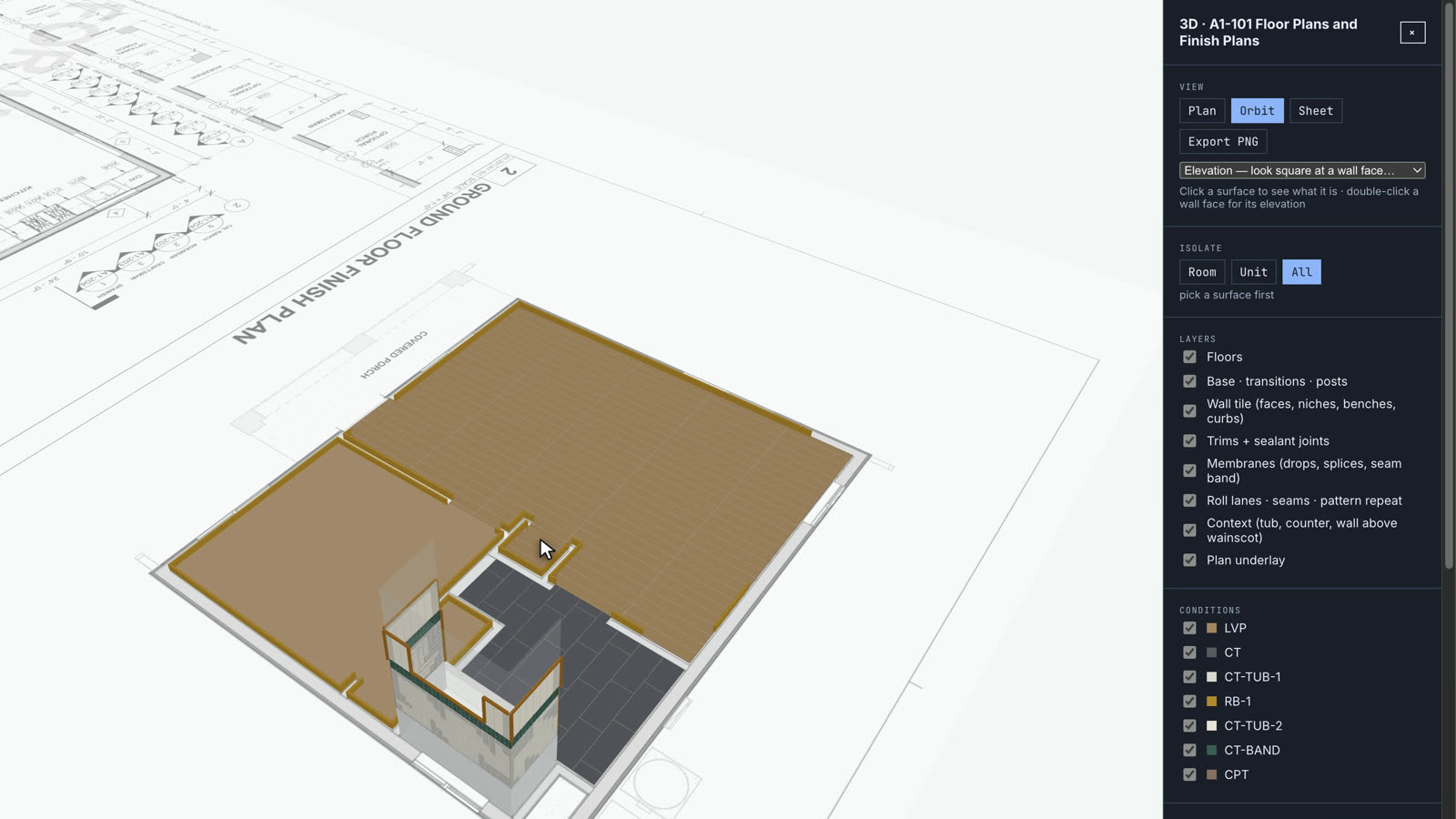
Native 3D, material layouts, and visual storytelling. Open any image for a closer look.
 PLAY ON YOUTUBE · 2:47
A continuous demonstration of the MCP workflow.
PLAY ON YOUTUBEFloors, walls, openings, and finishes in the native view.
 PLAY ON YOUTUBE
An agent works through a studio flooring takeoff.
I’ve installed floors, run crews, owned a flooring business, managed projects, and led commercial estimating. That experience shapes the software I build and the questions I ask of a model.
An estimate has to survive a real project. A model has to survive a real drawing. I care about the gap between an impressive demo and a system someone can depend on.
Through Kentucky AI, I build the tools, curate the data, and publish the work. I’m interested in AI teams solving difficult problems where domain expertise matters.
Recognition: Kentucky AI is an NVIDIA Inception program member. OpenTakeoff ranked #1 Tool / #2 overall on the BUIDL_QUESTS leaderboard on October 7, 2026 (Attention Award reference standings).
Domain-specific model development, failure analysis, data quality, and human review.
Tools that connect model capabilities to the workflows and decisions of real users.
Explore the room.
Measure the plan.
Challenge the score.
This is the actual Terracotta design-study geometry from Spline. Rotate the room, inspect the tile, or peel away layers to see how it is assembled.
Loading the Terracotta model…
Live 3D · native design geometryProposed design study, not an as-built model. Trim is exaggerated for visibility; architectural context is not a measured quantity. Viewer adapted from the OpenTakeoff/Spline work of Kevin N. Murphy and contributors. Credits & licenses
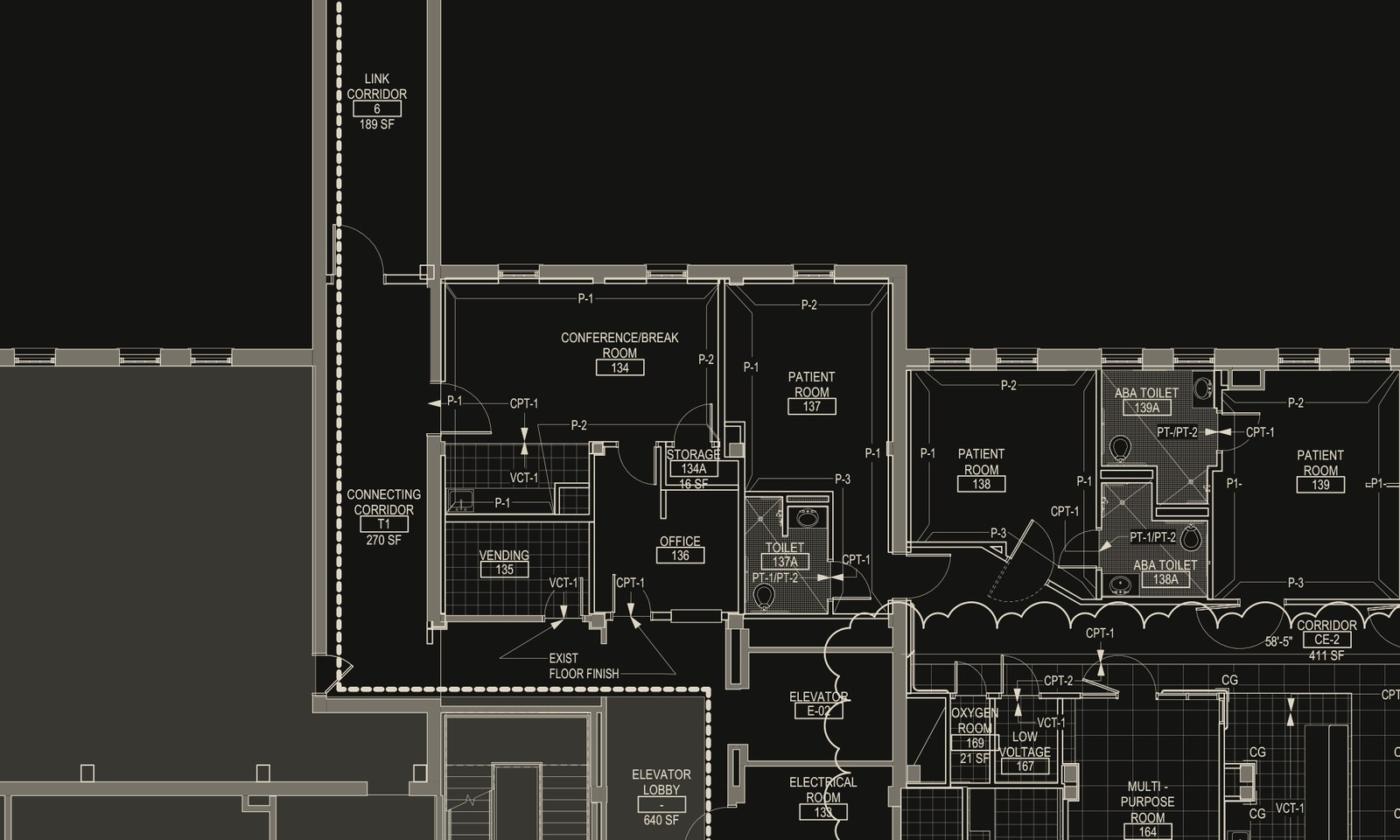
The public VA Building 28 finish plan, used in OpenTakeoff Academy. Add points around a room’s inside edges, then finish the shape. Every corner changes the area.
Scale follows the original 42 × 30-inch PDF at ⅛″ = 1′. Area is computed from your polygon, without waste or deductions. Scroll to move around the zoomed sheet. Public plan source
40 floor trials through OpenTakeoff MCP. Every model received the same five sheets. The saved geometry was scored against 66 approved floor regions.
One corrected-protocol trial per model/sheet. Vision and text-only input modes differ. Public scalar records reproduce the tables; private plans prevent an independent end-to-end rerun. Eight additional base/wall trials found no reliable complete takeoff.
Read the published protocol and resultsDownload public result recordsSelect a stage to inspect the actual tooling, artifacts, and checks.
An interactive explanation of documented work. No training job or inference service is running in this page.